
The IAA Mobility in Munich is where the future happens
From September 9 to 14, 2025, the international mobility trade fair “IAA Mobility” will take place in Munich. The name says it all. What once began as the International Motor Show has today become a trade fair that goes far beyond this theme. Everything revolves around mobility in general and technology, progress, innovation in particular. But those are only buzzwords. It is about much more. streetwheelz1 was present on the opening day of Europe’s most important and largest mobility exhibition and set out to capture its essence.

The IAA moves Munich. It is not an event that only takes place hidden somewhere on the exhibition grounds and of which the rest of the population is unaware. The whole city is in a festive mood during the five event days. For while the actual trade fair takes place a little outside at the exhibition grounds in Munich-Riem and focuses primarily on business people, the extensions of the IAA reach deep into the heart of Munich and bring plenty of fun especially to end consumers.
At around eight locations, including Marienplatz, Max-Joseph-Platz and Odeonsplatz, German and international car brands present their new models – surrounded by food stalls and even live music. Admission is free and attracts large crowds. A kind of fairground for car fans and for all who enjoy folk festivals.

One of the highlights is also the Motorworld site at Königsplatz. Various striking models are on display and create a car meet atmosphere: Ford GT 2005-2006, Amphicar 770 (1961 to 1968), Mercedes AMG GT Rally Edition and other vehicles adorn the square and visually interact with the monumental buildings. Also noteworthy is a rollover simulator from the Kreisverkehrswacht Kelheim e.V. Here, the daring can climb into a Mini Cooper, which is then rotated on a spit like a suckling pig.

The major German car brands Mercedes-Benz, Porsche, Audi, VW and Opel are of course set as the top dogs at the IAA, with Bavaria’s cult brand number 1, BMW, leading the way. This brand, founded here over 100 years ago, is also omnipresent in everyday life on the roads around Munich and in Bavaria. People drive BMW here. Encountering prototypes (“Erlkönige”) on the Deggendorf A92 motorway is also an everyday occurrence.

At the IAA – both at the exhibition grounds and in the Open Space – BMW’s Neue Klasse was unveiled as a world premiere. It is the first production model BMW iX3. This SUV presents a completely changed vehicle architecture for electric cars (new battery and drive system), an updated design with a new cockpit (panoramic display, 3D head-up display, etc.) and new technology (800-volt charging technology, more efficient motors, bidirectional charging). Porsche also presented its novelty in the Open Space: the new Porsche 911 Turbo S. For the first time, the centerpiece of Porsche’s 911 sports car series is equipped with a hybrid drive. Admittedly, it is (still) not about driving fully electric, but about increasing performance (better acceleration thanks to an increase from 650 hp to 711 hp) and efficiency (self-charging hybrid).
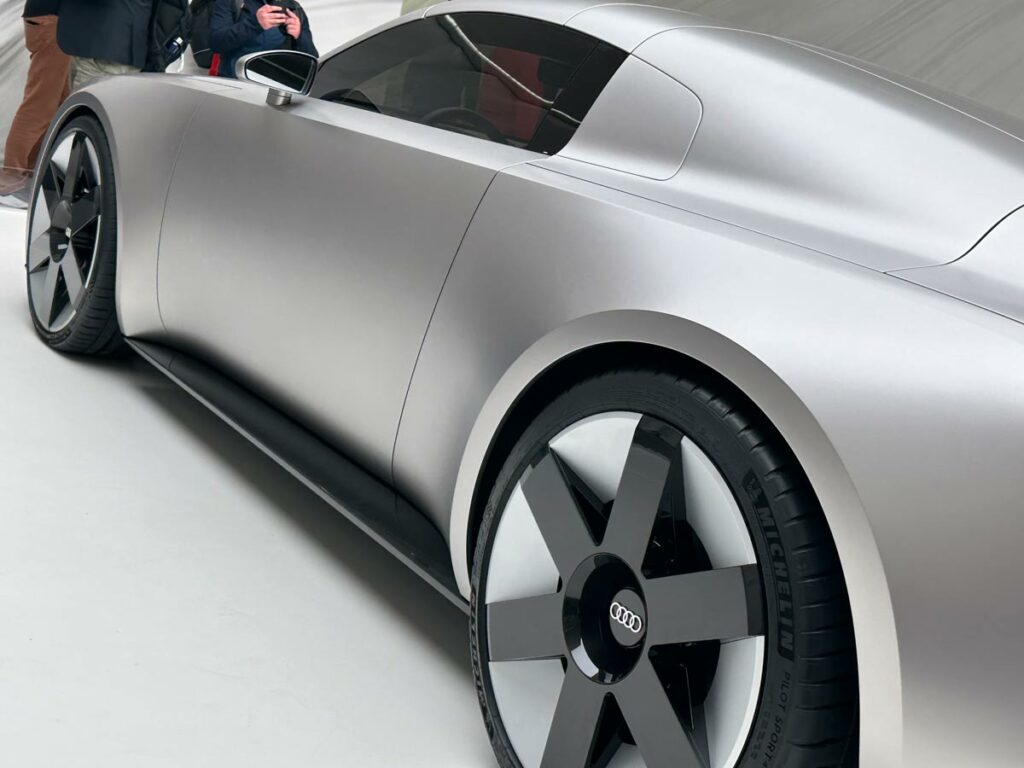
Audi, in turn, presented the Audi Concept C at Odeonsplatz, an all-electric sports car that could one day replace the Audi TT. The design is muscular yet elegant and, with its futuristic styling, could have sprung from a science fiction movie, especially with its striking color “Titanium,” a matte silver. Another world premiere drew attention in exhibition hall B3. Mercedes-Benz made a strong statement with the AMG CONCEPT GT XX in flashy “Sunset Beam Orange.” Since the AMG One (2017), this is the first foray into the hypercar segment. Here, a classic V8 is combined with hybrid power (approx. 1,000 hp, brutal aero, hybrid with racetrack character). This beast places itself in the same league as Pagani, Koenigsegg and Rimac Nevera. One can only wait to see what comes next. The concept car from Opel, the Corsa GSE Vision Gran Turismo, will of course be immediately recognized by gaming fans from the game Gran Turismo. Apart from that, it stands out instantly with its aggressive color and form design and its rally look.

These concept cars radiate the allure of the unattainable. For either no series production is planned, or the path to it is still a long one. But couldn’t this futuristic aesthetic find its way onto the streets more often? Many a car enthusiast would surely see it as an enrichment.

Alongside these local heroes, numerous European brands (e.g. Renault, Skoda, Cupra), selected American ones (Ford, Lucid) and above all many Chinese manufacturers (BYD, Xpeng, GAC, etc.) are also present. Definitely one can and must say: the competition never sleeps.

While the focus of the general public is thus more on the subject of automobiles or mobility, the IAA is also much more than that. For the vehicle innovations and concept cars are important, but only part of the overall trade fair concept. In the Riem exhibition halls, everything is geared towards B2B exchange. There is a startup area, there are networking areas, and there are in total six halls with exhibitors covering the most diverse future topics around mobility. On the IAA app, visitors can also see the daily highlights such as panel discussions or products put in the spotlight.
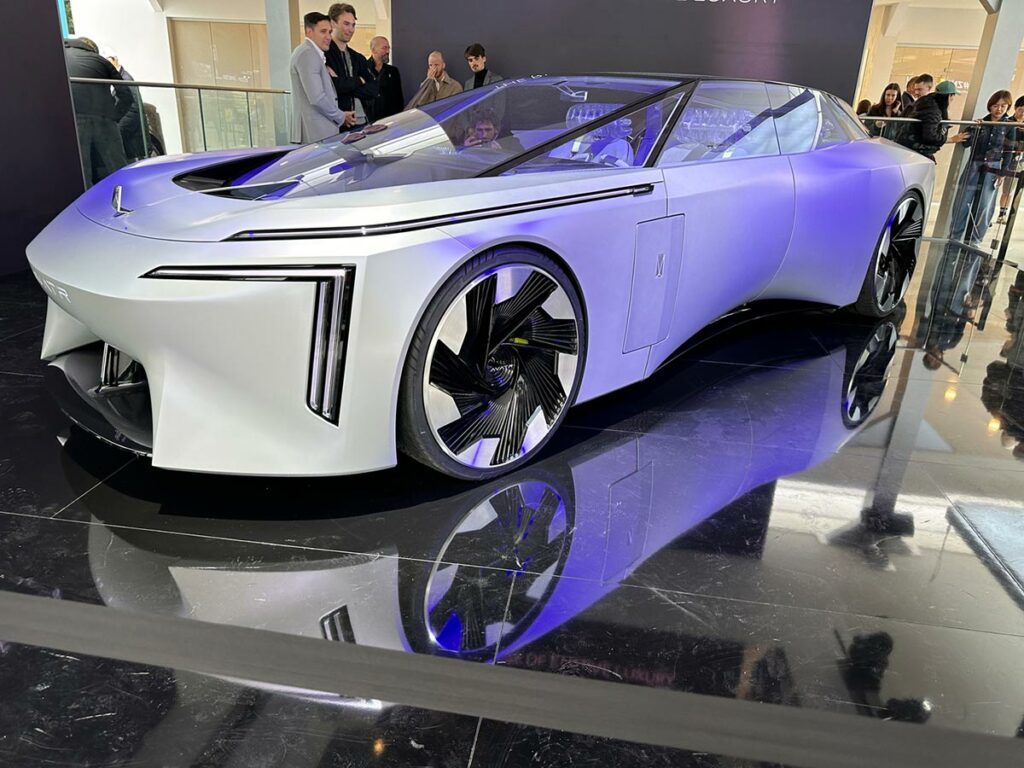
Monday, the first day of the fair, was entirely marked by high-level political visits: That the IAA does not simply play a central role for one or more industries, but for all of Germany, became clear at the latest when Federal Chancellor Friedrich Merz and the Minister-President of the Free State of Bavaria, Markus Söder, visited the fair as part of a tour.
The Chancellor emphasized in a short speech the importance of the automotive industry for Germany. It was important, he said, to promote innovation in Germany and support entrepreneurial spirit. Friedrich Merz said one must not “focus one-sidedly on certain technologies; it must, I have said this repeatedly today, be technology-friendly and set the right framework. This means, for example, that we have a reliable charging infrastructure and the rapid ramp-up of e-mobility (..).” Competitive framework conditions must be created, said Friedrich Merz, in order to remain a strong economy.

This openness to new technologies runs through the entire IAA. Technology should not become an end in itself but should move us forward. Literally and metaphorically. This is also evident when you look at the stands of the various exhibitors who are not car manufacturers but equip the vehicles and transport systems with their technology. These are many industries that indirectly and in some cases almost invisibly promote mobility. The Chinese provider YFORE, for example, offers a fully integrated digital driving experience with its “Intelligent Vehicle Clients.” This begins with access to the vehicle (via app, which can also be shared with others if desired), extends to an intelligent cockpit and electronic rear-view mirrors, and goes as far as driver assistants and traffic information. The South Korean company Hatbit Illucom Co. Ltd is focused on the development and production of automotive lighting systems. This includes interior and exterior lamps: headlights, ambient lighting, lighting devices on the radiator grille, design.
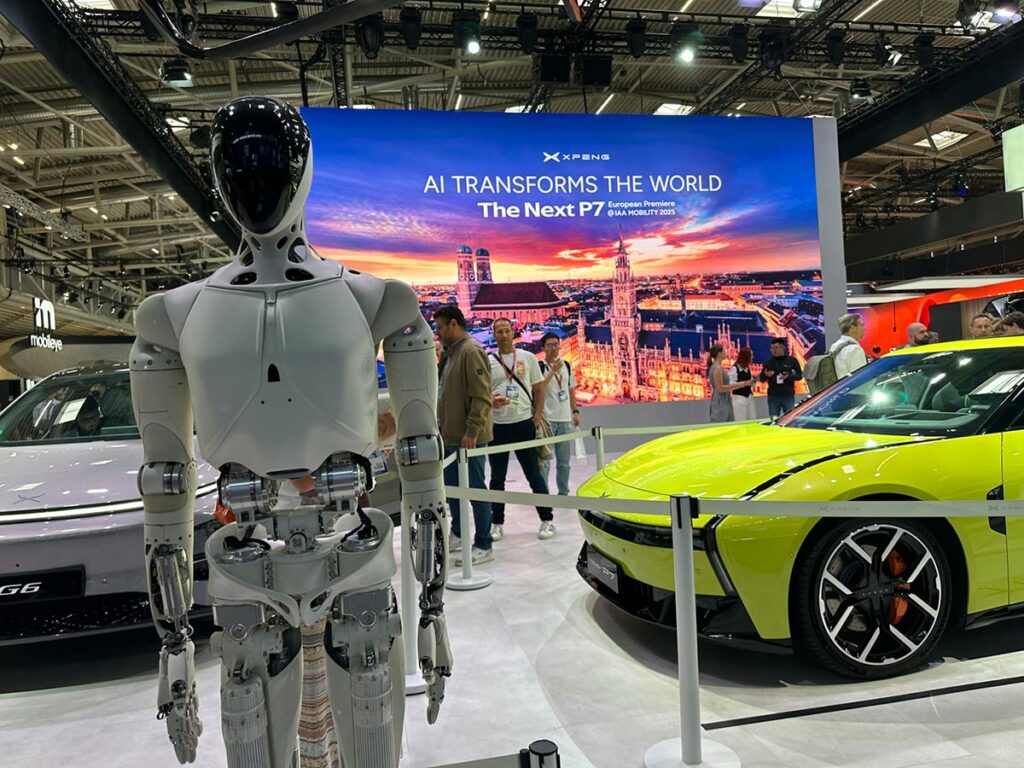
At the latest, when you spot the Google logo at the fair, it becomes clear that big data has long since found its way into the mobility industry. In general, exotic niche topics have developed into the buzzwords of the professional world. Today, literally almost every child is already working with AI. No wonder then that robots, artificial intelligence, self-driving cars and even flying vehicles are as much a fixed part of the IAA exhibition as the Govy AirCab flying taxi from manufacturer GAC (2 seats, 20–30 km range, approx. 120 km/h top speed).
One can say the IAA serves all stakeholders of innovation: from car fans to mobility users to the architects and residents of the future.

A beautiful symbol for the fair was also a DeLorean at the entrance. While the time machine from the movie Back to the Future is known to be powered by uranium, the previously known fuel is gasoline. However, the exhibited model is electrified. But even this technology is probably not the ultimate solution. As the Chancellor already said: It is not about focusing on a particular technology. For this is not an end in itself but should move us forward.

A quote attributed to Henry Ford sums up the spirit of this fair: “If I had asked people what they wanted, they would have said faster horses.” This danger fortunately does not exist thanks to future-oriented trade fairs like the mobility fair “IAA Mobility,” because here not only are the individual building blocks of technology brought together in an emergent way, but here the future truly happens. // Written by Claudia Ryf
Information about the exhibition:
The IAA Mobility takes place from September 9 to 14, 2025 in Munich-Riem as well as at selected locations in the Bavarian capital.
Website of the organizer: https://www.iaa-mobility.com


 English
  Deutsch
  Français
  Italiano
  Español
  Português
  日本語
日本語